Chapter 24C: Ethernet fallback boot in U-Boot
Suppose U-Boot is running, but the boot partition has no kernel. Ethernet can supply a replacement kernel and DTB without repairing that partition first. The trap is that a failed load leaves old bytes in RAM: a script separated only by semicolons can boot those bytes instead of taking its fallback.
This chapter builds a local-first loading policy for U-Boot v2026.04, commit 88dc2788777babfd6322fa655df549a019aa1e69. Each path reaches bootz only after both files load. The commands are for an isolated development network, not an authenticated production recovery service.
The modern port name remains mx6ull_pa_mini, its header mx6ull_pa_mini.h, and its base DTS imx6ull-pa-mini.dts. The supplied MINI V2.2 schematic establishes one RJ45, on ENET2, with an SR8201F at MDIO address 1. Earlier MINI revisions use LAN8720 at the same address. We will use that wiring, not the EVK’s two-port assumptions.
Hardware documentation is not a claim of a working link. Chapter 19’s vendor source selects an SMSC driver, and our initial build disables that network path. Section 22.7 compares the SR8201F-VB datasheet’s 0x001cc816 ID with the modern RTL8201F driver’s match table and enables CONFIG_PHY_REALTEK as a concrete candidate. Confirm the fitted PHY’s actual ID and behavior before a V2.2 network test. A source/datasheet ID match is stronger than a similar name or generic fallback, but still does not establish complete silicon compatibility, RMII timing or measured packet transfers.
24C.1 The real use case
The policy has three outcomes:
Local kernel and DTB load, and U-Boot hands control to Linux.
Local loading or a returning
bootzfails; U-Boot tries the network path.The network path also fails; U-Boot returns to the prompt.
This cannot recover a board on which U-Boot itself does not start. Nor does it detect that Linux later panics or cannot mount root: once control passes to the kernel, this script is no longer running. Watchdog and boot-attempt recovery are a separate subject in Chapter 24F.
24C.2 What this chapter is not
TFTP supplies kernel and DTB only. The example root filesystem remains on MMC. If that rootfs is broken, loading the kernel by Ethernet does not repair it. Chapter 24’s NFS-root workflow changes that assumption; a self-contained recovery initramfs is another design.
There is also no authenticity check on loose zImage and DTB files. TFTP has no image authentication. Chapter 24E explains why hashes alone do not solve this.
24C.3 Files changed in this chapter
File |
Responsibility |
|---|---|
|
Network, FEC/PHY, filesystem and scripting support. |
|
U-Boot control-DT wiring for FEC, MDIO and PHY. |
|
Guarded local/network environment helpers. |
Existing host TFTP root |
Matching |
The port must already initialize MINI Ethernet clocks and pads and qualify the revision’s PHY. This is v2026.04 migration work, separate from the old vendor configuration. A network command’s existence does not establish that the hardware is usable.
24C.4 Enable U-Boot network commands
Merge this configuration fragment into the Chapter 22 port:
CONFIG_NET=y
CONFIG_DM_ETH=y
CONFIG_FEC_MXC=y
CONFIG_PHYLIB=y
CONFIG_DM_ETH_PHY=y
CONFIG_CMD_NET=y
CONFIG_CMD_PING=y
CONFIG_CMD_DHCP=y
CONFIG_CMD_TFTPBOOT=y
CONFIG_HUSH_PARSER=y
CONFIG_HUSH_OLD_PARSER=y
CONFIG_CMD_MMC=y
CONFIG_CMD_FS_GENERIC=y
CONFIG_CMD_BOOTZ=y
CONFIG_CMD_FAT=y
CONFIG_FS_FAT=y
CONFIG_CMD_EXT4=y
CONFIG_FS_EXT4=y
For a preV2.2 LAN8720 MINI, CONFIG_PHY_SMSC=y selects the named LAN8710/LAN8720 driver; clocks, reset and negotiation still need testing. For the supplied V2.2 SR8201F design, retain Chapter 22’s source-checked CONFIG_PHY_REALTEK=y candidate, then compare the actual MDIO ID and test the chip-specific behavior. Do not enable another platform’s RTL8201F timing adjustment merely to make a link appear. In particular, do not transplant the vendor hook’s unchecked register 0x1f write of 0x8190 as a universal PHY fix.
CMD_FS_GENERIC provides the generic load used below; FAT/ext4 support handles the chosen filesystem. CMD_BOOTZ starts the loose ARM zImage. CMD_DHCP is optional for the static example, but permits the separate test in 24C.10. Retain 24B’s DM GPIO and i.MX pinctrl support for reset ownership.
In the prepared Ubuntu Bash terminal, run . ~/imx6ull/scripts/env.sh, require success, and use the established arm-none-linux-gnueabihf- compiler. Reconfigure and build out of tree as in 24B.3/24B.9; do not edit global shell setup.
24C.5 Device Tree check: FEC, PHY, and reset
The MINI V2.2 route is documented in schematic sheets 1 and 3, CORE sheets 5-6, and guide pp274-275:
Signal |
MINI route |
|---|---|
RMII MAC |
ENET2; ENET1 signals are exposed on P4, not a second onboard RJ45. |
MDIO / MDC |
GPIO1_IO06 / GPIO1_IO07 muxed to ENET2 management signals. |
PHY address |
1, from straps; unchanged across the documented PHY replacement. |
Active-low reset |
SNVS_TAMPER8 / GPIO5_IO08, net |
RMII reference |
ENET2_TX_CLK to the PHY TXC input; vendor setup supplies 50 MHz from the SoC. |
The RJ45 symbol and some differential-side nets retain ENET1 names on sheet 3. Follow the MAC-side ENET2 nets into U11; the connector label is not a second MAC connection. Likewise, the guide’s “two RJ45” sentence is an ALPHA carry-over, not MINI wiring.
Chapter 22 already supplies these routes and uses the FEC driver’s MAC-node reset properties. Keep that working integration as the starting point. The fragment below is an alternative PHY-uclass reset arrangement, not another reset owner to paste beside it. To study it, remove the MAC’s phy-reset-* properties first, then merge these properties into the existing mini_phy node. Do not duplicate PHY nodes or change reset ownership on hardware without a reviewed reason.
/ {
    aliases {
        ethernet0 = &fec2;
    };
};

&fec1 {
    status = "disabled";
};

&fec2 {
    pinctrl-names = "default";
    pinctrl-0 = <&pinctrl_enet2 &pinctrl_enet2_reset>;
    phy-mode = "rmii";
    phy-handle = <&mini_phy>;
    status = "okay";

    mdio {
        #address-cells = <1>;
        #size-cells = <0>;

        mini_phy: ethernet-phy@1 {
            reg = <1>;
            reset-gpios = <&gpio5 8 GPIO_ACTIVE_LOW>;
            reset-assert-us = <100000>;
        };
    };
};

&iomuxc_snvs {
    pinctrl_enet2_reset: enet2-reset-grp {
        fsl,pins = <
            MX6ULL_PAD_SNVS_TAMPER8__GPIO5_IO08 0x1b0b0
        >;
    };
};
pinctrl_enet2 must already contain the documented RMII and management signal muxing. The fragment omits that group and clock initialization deliberately; a DT node alone does not configure the SoC clock direction. The 100000 us assertion mirrors the vendor code’s 100 ms low pulse, not a verified SR8201F timing requirement. No post-release delay is invented here: add the fitted PHY’s required delay after checking its specification and measured supply/reference-clock startup. The reset pad-control value also requires electrical qualification.
In v2026.04, the Ethernet PHY uclass consumes these PHY-node reset properties with DM_ETH_PHY and DM_GPIO. FEC also supports the older MAC-node phy-reset-gpios, phy-reset-duration and phy-reset-post-delay, whose delays are milliseconds. Do not specify both paths for the same GPIO or mix their units.
GPIO5_IO08 is an SNVS/tamper pad: use the i.MX6ULL SNVS pin-function header and IOMUXC-SNVS, as above, not the main controller’s older i.MX6UL pad offsets. The reset line must not also be a recovery button, strap reader or C routine’s independently requested output. Choose one reset owner when migrating away from the vendor’s raw-GPIO routine.
24C.6 MAC address: do not ignore it
A valid Ethernet MAC is six bytes, nonzero and unicast. All-ones is broadcast and is invalid. Valid syntax does not imply ownership or uniqueness.
The modern fragment deliberately makes ENET2 Ethernet sequence 0, using ethaddr, with ENET1 disabled. Hardware MAC number 2 does not mean environment sequence 1. Sequence 1 uses eth1addr; inspect the built aliases and selected device rather than carrying over an EVK ethprime. The vendor header’s legacy CONFIG_FEC_ENET_DEV=1 selects the second hardware FEC, not this driver-model sequence contract.
Prefer an assigned, unique factory address from a documented source. A read-only SoC address may be usable if it is actually provisioned; a chip UID is not automatically a MAC allocation. An EEPROM/secure element/PMIC is only an identity source when the board has one with a defined record and provisioning process.
For an isolated lab, this is an example locally administered unicast address, not a shared default for every board:
=> setenv ethaddr 02:7a:60:00:00:01
Bit 1 of the first byte marks local administration; bit 0 is clear for unicast. Allocate a different address for each board on the lab network and check for collisions. Do not copy a vendor’s public prefix, and do not saveenv merely to run a network test. Existing environment protection may reject changing an already assigned ethaddr; do not enable blanket overwrite as a workaround. Chapter 24D uses an explicit identity policy and checks assignment errors.
24C.7 Manual Ethernet test
Use an isolated subnet that does not conflict with the host’s VPN or existing adapters. 192.168.7.1 for the host and .2 for one board are examples, not universal addresses.
Inspect the host’s current adapters using ip addr show. Use Chapter 24’s existing service setup rather than reinstalling packages or changing the host globally. With a qualified board and an interruptible autoboot:
=> setenv ipaddr 192.168.7.2
=> setenv serverip 192.168.7.1
=> setenv netmask 255.255.255.0
=> ping ${serverip}
There is no predicted board log here. Record the actual selected device and result. A failed ping can also be host ICMP filtering; it does not uniquely diagnose hardware. If initialization reports no controller/PHY, fix the driver, clock, reset, address and mux before attempting fallback.
24C.8 Manual TFTP test
Place the matching kernel and OS DTB in the already configured TFTP root from Chapter 24. imx6ull-pa-mini.dtb is the modern example’s OS-tree name; the vendor environment instead chooses imx6ull-alientek-emmc.dtb. Neither U-Boot’s control DT nor a renamed unrelated DTB substitutes for a kernel-compatible MINI OS tree. Creating a directory does not configure the server to use it. Do not disable the host firewall globally; diagnose the service and its allowed traffic. TFTP uses UDP port 69 for the initial request and a server-selected transfer port afterward.
The example RAM slots are:
Slot |
Address |
Qualification |
|---|---|---|
Kernel |
|
Kernel payload and self-decompression must not overlap reserved data. |
OS DTB |
|
DTB and later growth/relocation need space. |
Check bdinfo, actual file sizes, available DDR, U-Boot relocation/stack/malloc and boot memory limits. These addresses are not guarantees for every memory size or large image. A successful load does not mean the buffers were safely placed.
For a manual read-to-RAM test:
=> setenv kernel_addr_r 0x82000000
=> setenv fdt_addr_r 0x83000000
=> tftpboot ${kernel_addr_r} zImage
=> tftpboot ${fdt_addr_r} imx6ull-pa-mini.dtb
Inspect each result before proceeding. filesize describes the most recent successful load, not both files; failure may leave old RAM and old metadata. The automated scripts below use return status, not stale filesize, to decide whether boot is permitted.
24C.9 Local boot command
The complete header block in 24C.11 defines the commands. Read its local path first:
if mmc dev ${mmcdev} && mmc rescan; then
    if load mmc ${mmcdev}:${bootpart} ${kernel_addr_r} zImage && load mmc ${mmcdev}:${bootpart} ${fdt_addr_r} ${fdtfile}; then
        if run set_local_args; then
            bootz ${kernel_addr_r} - ${fdt_addr_r}
        else
            false
        fi
    else
        echo Local image load failed; false
    fi
else
    echo MMC unavailable; false
fi
This is the body of local_boot, not a Bash program or a prompt assignment. && stops after the first failure. Each failure branch ends in false, so an echo cannot accidentally convert failure into success. A bootz that returns reports its own status to the caller.
The - means no initrd. This example chooses the MINI TF slot on USDHC1 as local media, conventionally U-Boot mmcdev=0 in the vendor board code. The eMMC core’s USDHC2 is conventionally mmcdev=1; a NAND core does not gain eMMC merely by changing that variable. Confirm the modern port’s device sequences before use. Optional SDIO WiFi at P2 shares USDHC1 with TF, so do not fit/use that module while relying on this TF path.
The illustrative rootdev=/dev/mmcblk0p2 in the header must be checked against Linux’s MMC numbering. U-Boot mmcdev=0 does not prove Linux mmcblk0. A measured PARTUUID is often clearer; obtain it from the intended root partition, never invent one. To use eMMC instead, coordinate device, partitions, root arguments and matching kernel/DTB; do not merely change one number.
24C.10 Network boot command
The default network path deliberately uses static settings. It reapplies all three addresses before attempting TFTP, so no earlier DHCP attempt silently supplies different values. Both network loads must succeed before arguments are set and bootz is called.
DHCP is an optional separate test:
=> setenv autoload no
=> dhcp
autoload=no requests network configuration without the automatic boot-file transfer. If DHCP fails, printing “using static IP” does not restore overwritten or cleared variables. Explicitly reset ipaddr, serverip, netmask and any stale gatewayip before a static retry, as net_boot does below. If DHCP succeeds, its TFTP server and boot filename still need to match your intended server/payload; do not silently trust arbitrary DHCP boot options.
24C.11 Fallback boot command
This is a complete macro definition for the two loading paths and their dispatcher. Merge it into the existing header, retaining unrelated board defaults. Replace the normal_boot placeholder from 24B, and remove duplicate address/filename keys. Keep the non-booting recovery_boot until a real recovery image exists.
#define PA_MINI_NET_FALLBACK_ENV \
    "kernel_addr_r=0x82000000\0" \
    "fdt_addr_r=0x83000000\0" \
    "fdtfile=imx6ull-pa-mini.dtb\0" \
    "bootfile=zImage\0" \
    "mmcdev=0\0" \
    "bootpart=1\0" \
    "rootdev=/dev/mmcblk0p2\0" \
    "lab_ip=192.168.7.2\0" \
    "lab_server=192.168.7.1\0" \
    "lab_mask=255.255.255.0\0" \
    "set_local_args=setenv bootargs console=ttymxc0,115200 " \
        "root=${rootdev} rw rootwait\0" \
    "local_boot=echo Trying local MMC; " \
        "if mmc dev ${mmcdev} && mmc rescan; then " \
            "if load mmc ${mmcdev}:${bootpart} ${kernel_addr_r} zImage && " \
                "load mmc ${mmcdev}:${bootpart} ${fdt_addr_r} ${fdtfile}; then " \
                "if run set_local_args; then " \
                    "bootz ${kernel_addr_r} - ${fdt_addr_r}; " \
                "else false; fi; " \
            "else echo Local image load failed; false; fi; " \
        "else echo MMC unavailable; false; fi\0" \
    "net_boot=echo Trying static-IP TFTP; " \
        "if setenv ipaddr ${lab_ip} && setenv serverip ${lab_server} && " \
            "setenv netmask ${lab_mask} && setenv gatewayip; then " \
            "if tftpboot ${kernel_addr_r} ${bootfile} && " \
                "tftpboot ${fdt_addr_r} ${fdtfile}; then " \
                "if run set_local_args; then " \
                    "bootz ${kernel_addr_r} - ${fdt_addr_r}; " \
                "else false; fi; " \
            "else echo Network image load failed; false; fi; " \
        "else echo Network setup failed; false; fi\0" \
    "fallback_boot=if run local_boot; then true; " \
        "else echo Local path returned failure; run net_boot; fi\0" \
    "normal_boot=run fallback_boot\0"
Append this macro to CFG_EXTRA_ENV_SETTINGS once. Use CONFIG_USE_BOOTCOMMAND=y and CONFIG_BOOTCOMMAND="run normal_boot" from 24B. When board policy is enabled, its late hook selects either run normal_boot, run recovery_boot, or a blocked command. Do not replace that hook’s gate with an unconditional fallback bootcmd.
Successful kernel handoff does not return. Fallback can run after a failed load or a bootz error returned before handoff; it cannot run after a Linux failure. The true branch preserves success in a host mock or another returning command; it is not a “Linux finished” message.
24C.12 Make failure visible
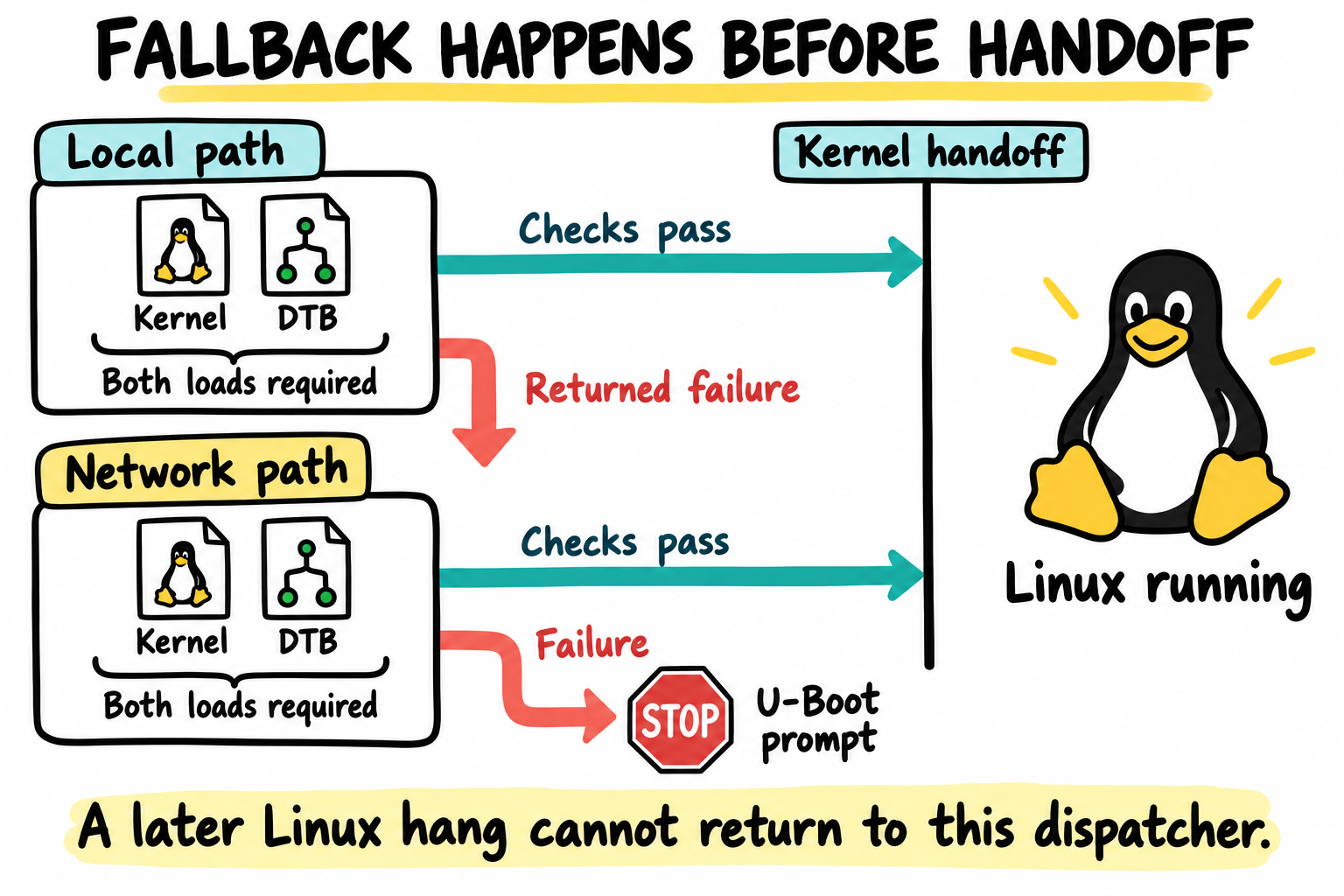
Fallback handles failures returned before kernel handoff. Both paths must load their complete image pair and pass argument checks. A later Linux hang requires a separate reset and recovery policy.
Log attempts at path boundaries, then keep the underlying load/PHY error. The code emits “Trying local MMC”, “Local image load failed” or “MMC unavailable”, and “Trying static-IP TFTP” as appropriate. Those are source strings, not promised serial output from this board.
Distinguish three observations in your notes: which path was attempted, whether each payload loaded, and whether handoff occurred. A TFTP transfer alone establishes none of the kernel’s rootfs, driver or application results.
24C.13 Optional: fetch a boot script
A legacy boot.scr is executable command input. Its CRC is not authentication. A trusted lab may use one, but fetching a script from an untrusted server grants that server whatever commands the build exposes, including potential storage writes. A signed kernel FIT does not authenticate an unrelated script.
For an isolated, deliberate lab only, the following is the complete content of boot.cmd, to create in the editor:
if tftpboot ${kernel_addr_r} zImage && tftpboot ${fdt_addr_r} imx6ull-pa-mini.dtb && run set_local_args; then
    bootz ${kernel_addr_r} - ${fdt_addr_r}
else
    echo Script image load or argument setup failed
fi
exit 1
The final exit 1 is outside the conditional. It reports failure if either load or argument setup fails, or if bootz returns instead of handing control to Linux. Successful kernel handoff never reaches it. In this pinned old-hush multiline source path, a nested conditional ending in false can still return status 0 to its caller, even though it correctly blocks handoff. Do not use that structure to report packaged-script failure. The pinned exit reference describes leaving the innermost script; the single-line run helpers in 24C.11 are unchanged.
Using the host mkimage built from the pinned source:
mkimage -A arm -T script -C none -n "pa-mini lab net script" -d boot.cmd boot.scr
With CONFIG_CMD_SOURCE and CONFIG_LEGACY_IMAGE_FORMAT deliberately enabled for this legacy lab script, a single guarded command is:
=> if tftpboot ${scriptaddr} boot.scr; then source ${scriptaddr}; else echo Script load failed; false; fi
Define and qualify a separate scriptaddr first, for example 0x84000000 only after the RAM map is checked. Do not default to executing remotely supplied scripts in production. Required FIT signatures, trusted configuration policy and a verified boot chain require a separate security design, not simply this source command with a different image nearby.
24C.14 Key Notes
Local-first fallback responds to load failures or a boot command returning before handoff. It cannot diagnose a later Linux failure or recover a bootloader that never starts.
Every path gates both payload loads and argument setup. Explicit failure status prevents an error message’s successful
echofrom making stale RAM bootable.TFTP supplies the kernel and DTB here, not the MMC root filesystem. Network loading does not repair a corrupt root or authenticate loose images.
ENET2 hardware numbering differs from driver-model Ethernet sequence numbering. The sole-interface
ethaddrcontract, unique MAC allocation and revision-specific PHY/reset/clock path remain distinct requirements.Static retry must restore actual address variables after DHCP. A message announcing static fallback does not restore state that an earlier attempt changed.
Filesystem loads need a qualified RAM and root-partition mapping even when they do not write storage. Remote legacy scripts carry executable authority and can bypass a separate signed-image path.
24C.15 Pitfalls
Semicolon-only loads. A later successful command can mask failure and boot stale data.
Last-command status.
echoreturns success; explicit failure branches must end in failure.DHCP retry state. A message does not restore static settings.
Rootfs assumption. TFTP kernel/DTB does not fix MMC rootfs corruption.
Reset domains and units. PHY-node microseconds differ from legacy FEC-node milliseconds.
Public or duplicate MAC. Use an owned factory address, or unique locally administered lab addresses.
Authentication. Loose payloads and legacy boot scripts are not trusted merely because they transfer successfully.
24C.16 Going deeper
Command Kconfig:
load, networking,bootz, hush and legacy script options.Network commands and BOOTP/DHCP: return paths and
autoloadbehavior.TFTP implementation: transfer ports, loading and retries. The pinned tree has no separate
dhcp.rstortftpboot.rst; inspectcmd/net.cfor those commands.Environment documentation: network variables and defaults.
FEC driver and PHY uclass: actual consumers of reset properties.
SMSC PHY driver and PHY matching/fallback: named LAN8720 support is not evidence of SR8201F qualification.
Vendor board header and board setup: historical controller, clock and PHY assumptions to audit during migration, not a tested V2.2 Ethernet result.
Previous: Chapter 24B: U-Boot board policy with GPIO and I2C
Next: Chapter 24D: Board identity and variant selection in U-Boot