Chapter 24E: Multi-variant FIT images and DT overlays
A FIT configuration is a set of references: this kernel, this DTB, and optionally this ramdisk or overlay sequence. Several configurations can share a kernel without duplicating it. One release artifact is possible, but every supported hardware combination still needs testing.
We will package Chapter 24D’s three display choices for one fixed MINI core/baseboard assembly: no panel, optional ID4342, or optional ID7016 at RGBLCD J1. The board connector and panel options are documented; the matching OS trees and automatic EEPROM selector are examples to implement and qualify. We then examine overlays separately.
The baseline is upstream U-Boot v2026.04, commit 88dc2788777babfd6322fa655df549a019aa1e69, for host study and modern MINI migration. These APIs and security options are not a promise about Chapter 19’s older vendor build. FIT means Flattened Image Tree. The DT-shaped container is not the OS hardware DTB stored inside it.
24E.1 The scenario
Example LCD option / MINI attachment |
FIT configuration |
Payload DTB |
|---|---|---|
0 / no panel |
|
|
1 / ID4342, 480 x 272 |
|
|
2 / ID7016, 1024 x 600 |
|
|
All three must share the same chosen early DDR/storage setup, kernel and MMC rootfs. Do not include the guide’s 256 MiB NAND core and 512 MiB eMMC core in this late display selector: ROM/DCD initialization has already happened. This example includes no initramfs; its arguments still point to MMC. One FIT is not automatically a full recovery image or an OTA transaction.
Use the MINI RGB888/I2C2/backlight/shared-reset wiring described in 24D, then complete timing, power and touch-controller details from the fitted module’s specification. The same-size ID4384 and ID7084 panels are not aliases for the two choices above. These files are not shipped MINI DTBs and have not been bench-tested. Late FIT selection cannot change the ROM/DCD initialization already performed.
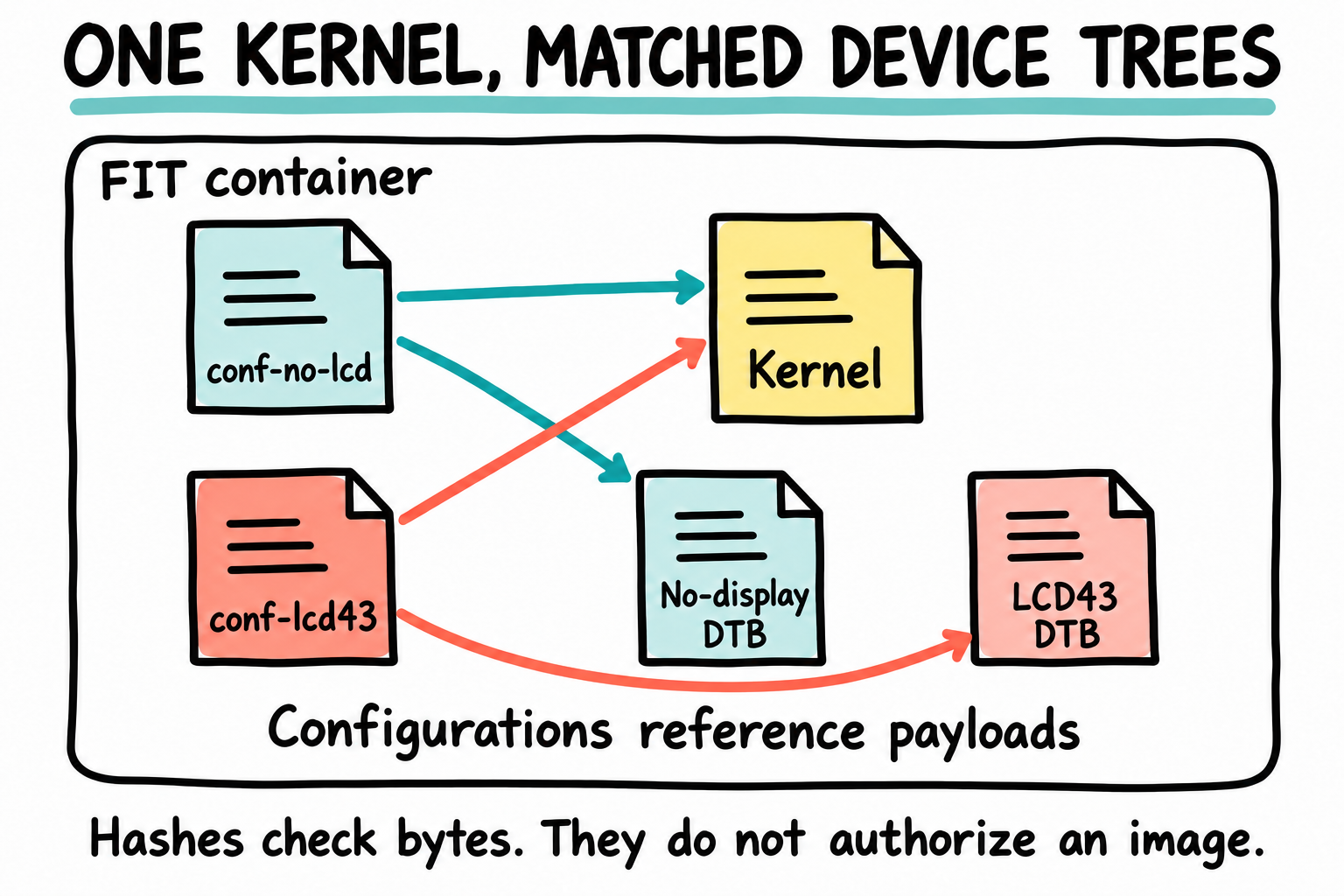
Configurations reference payloads rather than duplicating the kernel. Two of our three proposed combinations are shown here. Hashes check bytes against stored values, but trusted required signatures and boot policy are needed for authentication.
24E.2 The .its file with three configurations
Place matching zImage and qualified MINI OS DTBs beside this complete multi.its. No fallback default is specified: an explicit fixed-hardware choice or a validated add-on identity must select a supported configuration.
/dts-v1/;

/ {
    description = "mx6ull_pa_mini fixed-core display lab";
    #address-cells = <1>;

    images {
        kernel-1 {
            description = "Shared ARM Linux zImage";
            data = /incbin/("zImage");
            type = "kernel";
            arch = "arm";
            os = "linux";
            compression = "none";
            load = <0x82000000>;
            entry = <0x82000000>;
            hash-1 { algo = "sha256"; };
        };
        fdt-no-lcd {
            description = "MINI no-display OS DTB";
            data = /incbin/("imx6ull-pa-mini-no-lcd.dtb");
            type = "flat_dt";
            arch = "arm";
            compression = "none";
            hash-1 { algo = "sha256"; };
        };
        fdt-lcd43 {
            description = "MINI ID4342 480x272 OS DTB";
            data = /incbin/("imx6ull-pa-mini-lcd43.dtb");
            type = "flat_dt";
            arch = "arm";
            compression = "none";
            hash-1 { algo = "sha256"; };
        };
        fdt-lcd70 {
            description = "MINI ID7016 1024x600 OS DTB";
            data = /incbin/("imx6ull-pa-mini-lcd70.dtb");
            type = "flat_dt";
            arch = "arm";
            compression = "none";
            hash-1 { algo = "sha256"; };
        };
    };

    configurations {
        conf-no-lcd {
            description = "No display";
            kernel = "kernel-1";
            fdt = "fdt-no-lcd";
        };
        conf-lcd43 {
            description = "ID4342 4.3-inch display";
            kernel = "kernel-1";
            fdt = "fdt-lcd43";
        };
        conf-lcd70 {
            description = "ID7016 7-inch display";
            kernel = "kernel-1";
            fdt = "fdt-lcd70";
        };
    };
};
In the prepared Bash environment (. ~/imx6ull/scripts/env.sh, successful status), use host tools built from the pinned source:
mkimage -f multi.its multi.itb
mkimage -l multi.itb
stat -c '%n %s bytes' multi.itb
These write host artifacts, not board storage. Size depends on the actual inputs; there is no promised megabyte count. Listing the FIT is not a boot or signature-validation test.
For the unsigned example, enable FIT, FIT_FULL_CHECK, SHA256, CMD_BOOTM and the filesystem/hush support in 24D. Retain the port’s ARM Linux boot support. Disable FIT_BEST_MATCH if omission of an explicit configuration should fail rather than attempt compatible matching. Our policy always names the configuration.
24E.3 Booting a specific configuration
Stage the FIT separately from its kernel destination: here fit_addr_r=0x85000000, while the kernel loads/enters at 0x82000000. Do not stage this FIT at its own kernel load address and rely on an overlapping copy.
For a later qualified board test with an ID4342 panel and the selected fixed core, with correct root arguments already established:
=> if load mmc ${mmcdev}:${bootpart} ${fit_addr_r} multi.itb; then bootm ${fit_addr_r}#conf-lcd43; else echo FIT load failed; false; fi
24E.6 defines the variables and arguments. Manual explicit selection can also study FIT on a stock MINI with no identity EEPROM: choose conf-no-lcd when no panel is fitted, or the configuration for the actual module. Do not manufacture identity_ready=1 to bypass the EEPROM-mode helper. The attached # suffix is part of the bootm argument, not a shell comment. An unknown configuration fails, rather than selecting a nearby name. Without explicit selection, FIT defaults and matching options affect behavior; this FIT has no default property.
U-Boot resolves the selected image references, checks them according to verification policy, loads the kernel at its declared destination and prepares the OS DTB. compression="none" describes the outer payload; the zImage still decompresses itself. The DTB has no fixed load here, so U-Boot’s FDT relocation policy applies. Its final address is not necessarily the FIT staging address.
Qualify usable DDR, actual sizes, kernel decompression, FDT growth/relocation, and U-Boot stack/malloc/reservations using the real RAM map and bdinfo. A reserved FIT window of, for example, 32 MiB at 0x85000000 is a packaging constraint, not a runtime bounds checker. These addresses do not guarantee safety for another memory size or large image.
Hashes and trusted selection
SHA-256 detects changed payload bytes when verification runs. It does not authenticate the producer: an attacker can replace payload and hash. Missing hash children are not equivalent to an enforced required signature. Keep example verification enabled and inspect hash nodes, but do not call an unsigned FIT trusted boot.
A product needs required signatures checked against trusted public keys in U-Boot’s control DT, a verified chain to that U-Boot, and a policy binding the allowed kernel/DTB/overlay combination. CONFIG_FIT_SIGNATURE=y alone neither installs trusted keys nor requires signatures. Individually signed images without authenticated configuration policy can permit unwanted recombination. A valid signed configuration also does not prove it is allowed on this board; trusted identity and selection must decide that.
Mutable environment, alternate unsigned boot paths, prompt access, writable EEPROM identity and rollback need separate treatment. No key-enrollment, production-signing or fuse-programming procedure is provided. Read the pinned signature design for image versus configuration authentication.
24E.4 Detecting which variant we are running on
Automatic add-on selection happens before bootm, in the single 24B/24D board hook. A stock MINI has neither our proposed EEPROM nor dedicated variant straps; use an explicit fixed-hardware selection until such an identification design exists. Use fitconf consistently, not a second variant variable with different names.
Pattern A, Strap pin
Request dedicated input descriptors, check errors, allow levels to settle and sample for stability. Follow 24B.10’s ownership/polarity/cleanup method, but qualify strap timing separately from mechanical-key debounce.
This is a proposed dedicated add-on strap mapping table, not MINI wiring or pin-reading code:
Qualified logical state |
Selection |
|---|---|
00 |
|
01 |
|
10 |
|
11, changing readings or read failure |
Closed gate; unsupported identity. |
No GPIO1_IO09/IO10 wiring is asserted. Do not repurpose MINI BOOT_CFG1, KEY0, ENET2 reset or the LCD_DATA7/15/23 panel-ID/boot-strap circuit as generic free inputs. Reading the stock panel ID requires its own SGM3157 switching/pad-ownership sequence; this table does not implement that. Floating straps cannot be fixed with a software default. GPIO5/SNVS pads need IOMUXC-SNVS configuration if actually selected.
Pattern B, EEPROM ID
With the optional EEPROM on MINI I2C1/P4 fitted, use 24D’s DM-I2C reader and full 64-byte validation: magic, version, length, CRC, options, valid MAC and bounded serial before publishing fitconf and identity_ready. It propagates binding/allocation errors and explicitly sets pointer width. The stock schematics do not contain this EEPROM; the record’s profile revision is not a MINI silkscreen or an automatic panel probe.
Do not substitute legacy global-bus i2c_read() or one unvalidated byte. Reading one byte to RAM and then using setexpr.l consumes a whole word, including three unrelated bytes. There is no reason to use the future kernel/FIT buffer as identity scratch space.
Factory provisioning and readback remain separate. Reprogramming live identity is not a normal boot step or a lab example here.
Pattern C, eFuse
Already-provisioned, documented read-only fields may identify a chip. They require the exact fuse map, field ownership and board mapping. A one-time value is not automatically confidential or authenticated board-option data, or proof of tamper resistance.
There is no generic “spare OCOTP word” in this example and no burn guidance. Reserved/security/boot fields are not interchangeable with identity storage. Use host records or schematic-qualified straps/EEPROM reads for the example.
24E.5 DT overlays, the alternative
An overlay adds or changes nodes/properties in a base DT. It suits optional blocks on a qualified common base. For MINI, keep the chosen core, storage and onboard ENET2 PHY in the base; a display or camera add-on must describe its real connector and resources. LCD touch and camera share I2C2, and display ID pins share boot-strap circuitry, so “optional” does not mean independent or conflict-free. An overlay cannot supply missing SR8201F driver support or fix an already executed DCD.
It is not a general runtime deletion mechanism: DTS source deletion directives are not arbitrary deletion operations carried through fdt apply.
This complete host-only pair changes a demonstration property, not display/PHY/power wiring. Never pass the toy base to Linux as the MINI hardware DTB.
lab-base.dts:
/dts-v1/;
/ {
    model = "Host overlay fixture, not a board DTB";
    compatible = "myorg,overlay-fixture";

    lab: lab-options {
        display-option = <0>;
    };
};
lab-lcd43.dtso:
/dts-v1/;
/plugin/;

&lab {
    display-option = <1>;
};
Compile and merge on the host:
dtc -@ -I dts -O dtb -o lab-base.dtb lab-base.dts
dtc -@ -I dts -O dtb -o lab-lcd43.dtbo lab-lcd43.dtso
fdtoverlay -i lab-base.dtb -o lab-combined.dtb lab-lcd43.dtbo
fdtget -t x lab-combined.dtb /lab-options display-option
The resulting property should be 1. Both label-referencing inputs use -@; base symbols and overlay fixups allow the label to resolve. Real DTS files using preprocessor includes/macros need their normal build preprocessing, not an unqualified direct dtc call.
For optional read-to-RAM board inspection, qualify nonoverlapping fdt_addr_r/fdtoverlay_addr_r slots with 0x2000 extra bytes after the base:
if load mmc ${mmcdev}:${bootpart} ${fdt_addr_r} lab-base.dtb; then
    if load mmc ${mmcdev}:${bootpart} ${fdtoverlay_addr_r} lab-lcd43.dtbo; then
        if fdt addr ${fdt_addr_r} && fdt resize 2000 && fdt apply ${fdtoverlay_addr_r}; then
            fdt print /lab-options
        else
            echo Overlay failed - reload both originals; false
        fi
    else
        echo Overlay load failed; false
    fi
else
    echo Base load failed; false
fi
This is a complete compound U-Boot command, shown across lines for reading, not a Bash program. It deliberately does not boot. fdt addr without -c selects the working FDT; for real boot that must be a separately loaded OS DTB, never U-Boot’s live control DT at fdtcontroladdr.
fdt resize 2000 parses hexadecimal: 8192 extra bytes, not decimal 2000. It changes the declared buffer size, not RAM allocation or neighboring-image bounds. Too little space causes an error, not silent truncation. Apply mutates its inputs; libfdt invalidates them on failure. Reload both originals before retrying. Do not boot after failure or assume the base remains untouched.
Trade-offs vs separate DTBs
Choice |
Separate DTBs |
Base plus overlays |
|---|---|---|
Source maintenance |
Share |
Maintain shared labels and ordered sets. |
Failure handling |
Select a qualified DTB |
Stop on merge failure; reload inputs. |
Validation |
Each complete board tree |
Each supported final combination and ordering. |
Shipping |
Several FDT image nodes |
Base/overlays can also be FIT image nodes. |
There is no universal variant-count threshold. Overlays help only when shared hardware and combinations justify their additional contracts.
For automatic FIT overlays, define the compiled base and overlays as separate type="flat_dt" image nodes, each with a hash. With OF_LIBFDT_OVERLAY, this is a replacement configuration fragment, not a complete ITS:
conf-lcd43 {
    kernel = "kernel-1";
    fdt = "fdt-base", "overlay-lcd43";
};
Define fdt-base and overlay-lcd43 under images with actual data. The first FDT is the base; later entries apply in order. The pinned interface also supports bootm <addr>#<base-config>#<extra-config> for deliberately selected add-ons. Do not accept arbitrary extra names from unauthenticated identity. A signed design must authenticate and permit the complete selected combination.
24E.6 Putting it together, the full multi-variant boot script
For the EEPROM-equipped example, use 24D’s C identification and 24B’s gate ordering. This complete macro replaces 24C’s normal path with local FIT boot; it does not silently fall back to unsigned network payloads. A stock fixed-hardware MINI uses the explicit configuration route in 24E.3 instead, not this mandatory-EEPROM dispatcher.
#define PA_MINI_MULTI_FIT_ENV \
    "fit_addr_r=0x85000000\0" \
    "fitfile=multi.itb\0" \
    "mmcdev=0\0" \
    "bootpart=1\0" \
    "rootdev=/dev/mmcblk0p2\0" \
    "set_fit_args=setenv bootargs console=ttymxc0,115200 " \
        "root=${rootdev} rw rootwait\0" \
    "boot_multi=if test \"${identity_ready}\" = \"1\"; then " \
        "if mmc dev ${mmcdev} && mmc rescan; then " \
            "if load mmc ${mmcdev}:${bootpart} ${fit_addr_r} ${fitfile}; then " \
                "if setenv verify yes && run set_fit_args; then " \
                    "bootm ${fit_addr_r}#${fitconf}; " \
                "else echo FIT argument setup failed; false; fi; " \
            "else echo FIT load failed; false; fi; " \
        "else echo MMC unavailable; false; fi; " \
    "else echo Identity not ready; false; fi\0" \
    "normal_boot=run boot_multi\0"
Merge once into CFG_EXTRA_ENV_SETTINGS, removing conflicting definitions of the same keys. Keep CONFIG_BOOTCOMMAND="run normal_boot"; the late hook still installs blocked, normal or recovery dispatch. There is no default fitconf in this macro.
The example follows 24C’s TF/USDHC1 path, without an SDIO WiFi module on the shared bus. Confirm the modern port’s device sequence and Linux’s actual root partition; U-Boot ${mmcdev} does not establish its /dev/mmcblk name. eMMC/USDHC2 requires coordinated media/root arguments on an eMMC core. Adding a FIT ramdisk later requires coordinated ITS, argument and memory changes, not simply an extra rootfs.cpio.gz reference.
Mutable verify=yes enables corruption checking in this unsigned example. It is not required-signature enforcement or a bypass-resistant boot policy. Alternate boot routes must independently obey the final product’s trust requirements.
24E.7 Key Notes
FIT configurations share payloads through named references. One bundle simplifies release bookkeeping but does not reduce the set of hardware combinations that need qualification or make updates atomic.
Explicit fixed-hardware selection and validated add-on identity are different dispatch modes. This container supplies no default configuration for unknown hardware.
FIT staging, kernel destination/decompression and FDT growth have separate memory ownership. Metadata can describe destinations without checking that the chosen windows are safe.
Required signatures, trusted keys and authenticated configuration policy address different trust questions from payload hashes. A signed combination still needs authorization for the actual board.
Overlays mutate a separately loaded OS tree, not U-Boot’s live control FDT. Symbols/fixups and application order are interfaces, and a failed apply requires fresh base and overlay inputs.
Separate complete DTBs trade larger artifact sets for simpler final-tree selection. Overlays reduce shared-source repetition only when their combination and failure contracts justify the extra machinery.
24E.8 Pitfalls
One artifact mistaken for one test. Validate every supported final combination.
Overlapping staging/destination. Keep FIT clear of kernel decompression and relocated U-Boot.
Unknown identity mapped to a default. No variant is automatically safe for unknown hardware.
Hash mistaken for authentication. Payloads and hashes can be replaced together.
Control DT mistaken for OS DTB. Do not mutate driver model’s live tree.
Failed overlay reused. Reload base and overlay originals.
Source deletion mistaken for merge behavior. Inspect the actual resulting tree.
24E.9 Going deeper
FIT source format and implementation: references, selection and hashes.
FIT overlays: ordered FDT lists and extra configurations.
Manual overlays, FDT command and libfdt apply: working-tree mutation and errors.
FIT signatures and boot Kconfig: support versus required trusted signatures.
Previous: Chapter 24D: Board identity and variant selection in U-Boot
Next: Chapter 24F: Watchdog, bootcount, and rollback in U-Boot